Corporate Sales
Proposals, profiles and client-meeting documents.
Six illustrative Alide-branded mockups. Designs show possible uses; they are not photographs of completed customer orders. Final materials and details are agreed in your quote.
Present proposals, admissions material and business documents in branded presentation folders, with pockets and card slots matched to the contents.
Explore the full product guideMOQ, material, price and schedule depend on the approved brief. Confirm delivery availability using your city and PIN.
Proposals, profiles and client-meeting documents.
Admission packs and institutional information.
Approved information bundles and presentations.
Project handovers and delegate material.
Presentation Folders can bring a consistent identity to a practical business touchpoint. Measure the complete document set, not only one sheet. Pocket depth, spine allowance and card-slot position need to fit the planned contents without obscuring important information.
Typical uses include: Corporate Sales: Proposals, profiles and client-meeting documents.; Education: Admission packs and institutional information.; Healthcare: Approved information bundles and presentations.; Real Estate & Events: Project handovers and delegate material.
The value of this format comes from matching the design to its purpose. Doctor and presentation folders that keep literature, proposals and reports organised, with branded pockets and card-slot options. Plan the visible information, handling and presentation together so the finished item works for the people who receive it. A clearly agreed brief helps the sales and production discussion focus on the details that affect the result.
Begin with the reader and the action you want to make easier. Group information into a clear sequence, give headings a specific purpose and use images that explain the offer. A brochure may introduce the business, while a catalogue needs a repeatable system for comparing products. Plan folds and pages only after the content has been reviewed, so important details do not end up cramped at the end.
Choose paper, page count and binding around how the item will be handled and distributed. Heavier stock changes both the feel and the folded bulk. Review image quality, text size and colour expectations on an appropriate proof, and check all response details at actual size. If the campaign has several versions or languages, agree a naming and approval system before files reach production.
Measure the complete document set, not only one sheet. Pocket depth, spine allowance and card-slot position need to fit the planned contents without obscuring important information.
Review the artwork at its finished size, including small lettering, image detail and the position of the logo. Identify each version clearly if the order includes different products, names, languages or layouts. For pharmaceutical or institutional communication, use content approved by the authorised team. Check the final proof against the agreed format and confirm corrections together before production begins.
Start with the intended use, approximate quantity and artwork status, then share the product-specific information below. The team can discuss the undecided details with you. Material availability, minimum quantities, samples, price and scheduling are confirmed in the quotation, rather than inferred from an illustrative image.
For delivery enquiries, include the destination city and PIN, the required date and any packing or version-separation needs. Agree what is included in the order, who supplies the final artwork and how the proof will be approved. This gives both sides a useful reference for the finished specification and any repeat order.
Tell Alide how you want to use presentation folders. Share your artwork or a reference, and we can discuss a suitable specification and quotation.
Share the catalogue dimensions and thickness. A gusset or different structure may be needed.
Yes, discuss the card dimensions and slot position when reviewing the die line.
Finalise the insert fit, pockets and folds first so artwork can be placed correctly on the approved structure.
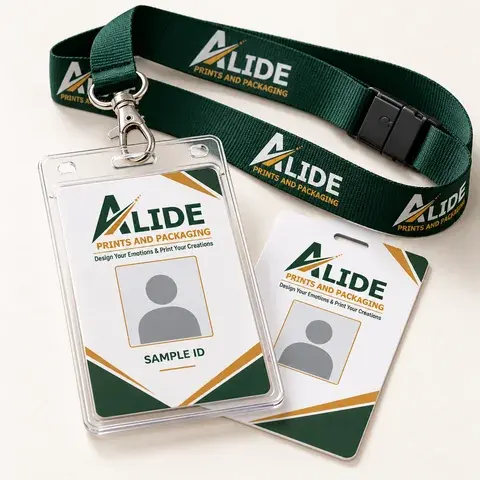
Choose an ID-card layout, holder and lanyard around real use. This guide covers variable data, orientation, readability and sample checks.
Read article →Create a coherent stationery brief while keeping transaction forms, document folders and recognition certificates fit for their different jobs.
Read article →Check names, message hierarchy, paper, writing space and presentation before approving personalised greetings or recognition certificates.
Read article →